
PATTERN 36:The Fox Fairy 狐狸精
The Silken Warp of Master Fahng, Chapter Two 紡師婆的緆經, 卷二

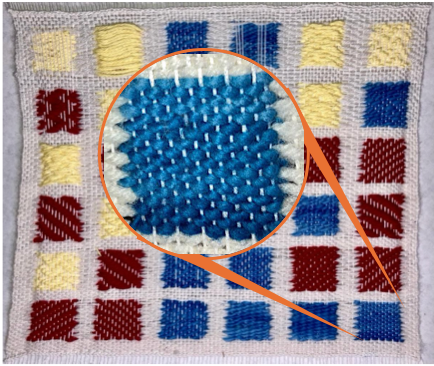

This is plain weave 平紋 pingwen. Tabby. We all learn tabby as little girls and weave it forever. It is straight and square; tight and strong; simple and beautiful. If you’re working on a workshop loom and only making tabby cloth, you step on treadle one to raise heddle harness one. Its heddles lift every odd thread: XOXOXO repeated a hundred times the width of your cloth. It makes a mouth in the warp; you throw the shuttle through, and the weft thread fills it. You beat it home, and you let go of treadle one and dance to treadle two. It raises harness number two that holds the even number threads. OXOXOX. And so on.
You see how these two gua are one Pattern? It’s only different in the direction you read it. Read it up and down as in the Mystery (where we call Patterns like this Upside-downs 綜 zong) or back and forth like throwing your shuttle. Back and forth and back and forth. Dance the treadle, throw the shuttle, beat it home, change the warp 踏板; 投梭; 打平; 易经 tàbǎn; tóusuō; dǎpíng; yìjīng. The rhythm of the loom.
On your first throw, the even warp ends are CROSSED and covered in the finished cloth; the odds are NOT CROSSED. They show through. Coming back, the odds are CROSSED. So those are the names of these two gua in our Mystery: CROSSED going up, NOT CROSSED coming back down 既濟 jiji 綜 zong 未濟 weiji. CROSSED NOT CROSSED comes at the end of the Mystery.
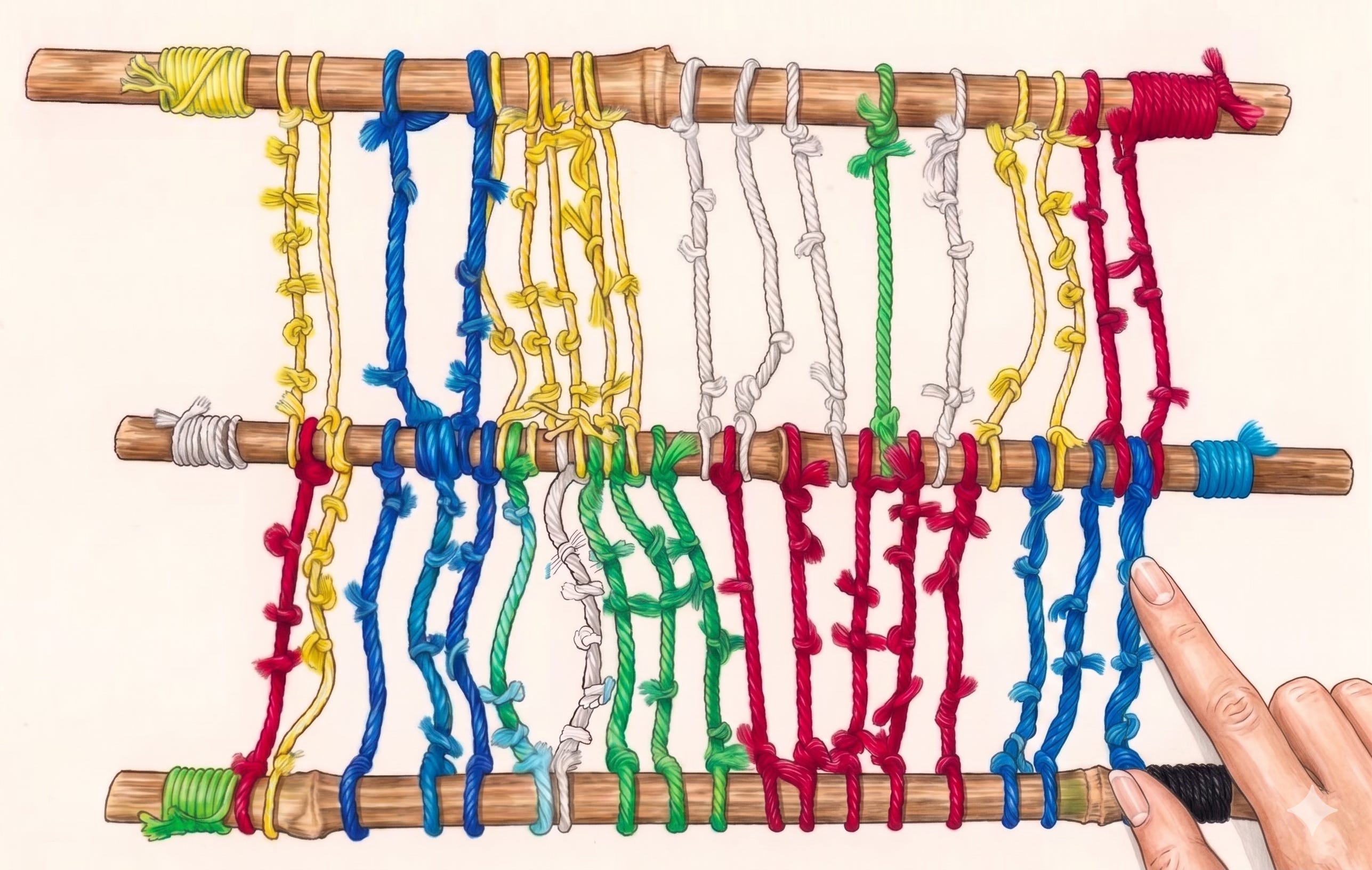
She is at the end of the Mystery, but she is its womb. Its beginning. She has six children of her own—the Patterns that are only different by one knot or empty space. Five of the six live together at the beginning of the Mystery—here, after the two royal satins.
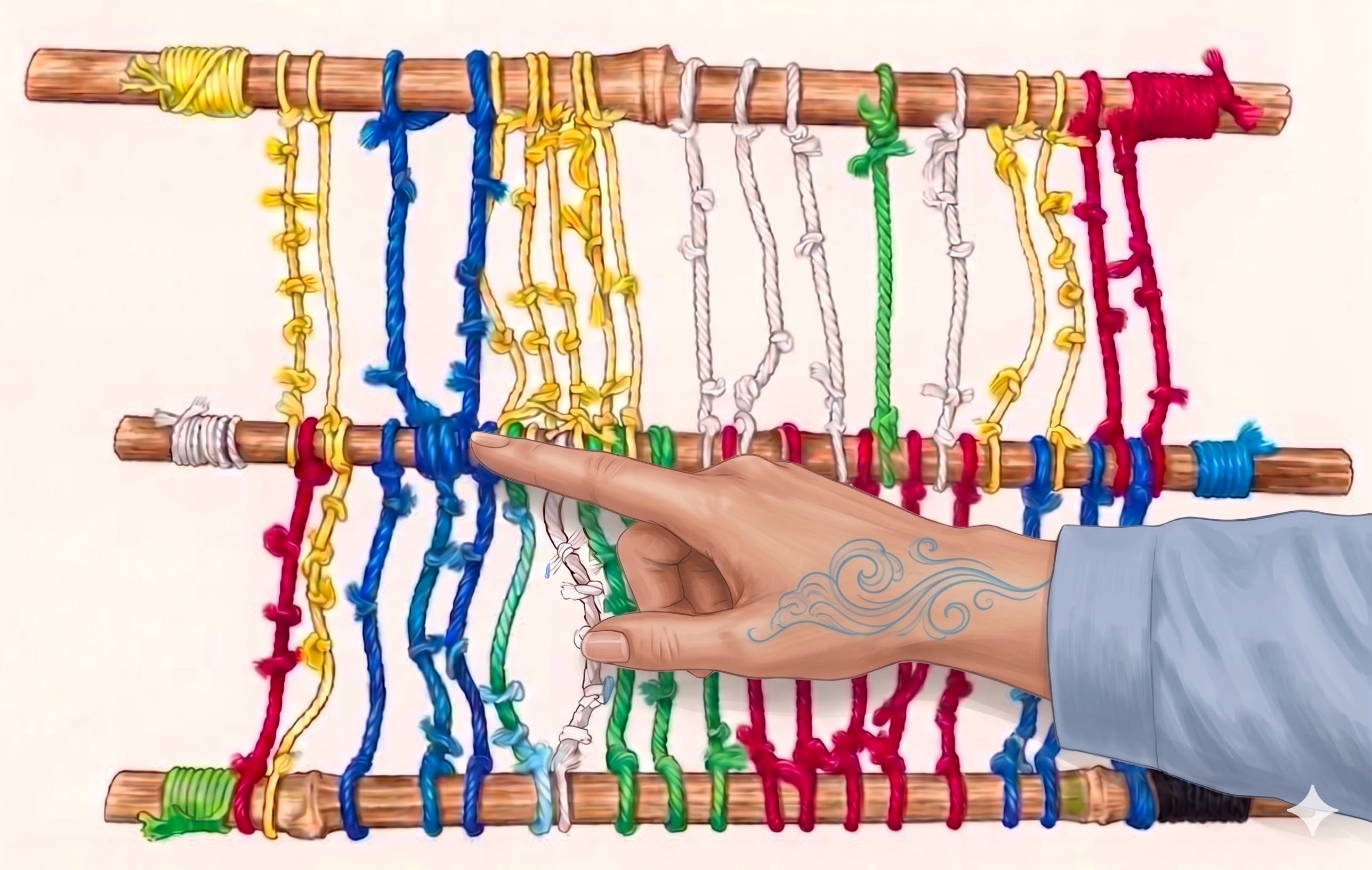
They give birth to all the other Patterns. Tabby is Nyuwa 女媧, the Queen Mother of the West 西王母 xiwangmu, and Heng’e姮娥, goddess of the moon. Our grandmother weavers.
The cloth we must give for taxes is white tabby. In all the states of the Central Plain 中原 zhongyuan silk is money. Like silver for big money or cowrie shells for little money. The Duke’s treasury uses silk to pay officials and soldiers—so many bolts per year depending on your rank. Those people may have some of it made into clothes, but a lot goes from hand to hand as money. Merchants trade with it for goods from cities nearby. Salt, iron ingots, horses, jade—whatever they want to bring to Morning Song to sell. Eventually, it ends up with a mercer, who dyes it or prints on it with copper stamps and sells it to tailors. Tailors cut it on the bias and sew it into skirts and jackets and robes.
You make stripes in tabby by alternating colors of yarn in the warp or weft or both. You can embroider decorations later, too. Or, if your loom has a flower tower, the sister above can pull extra heddle strings that add a design.
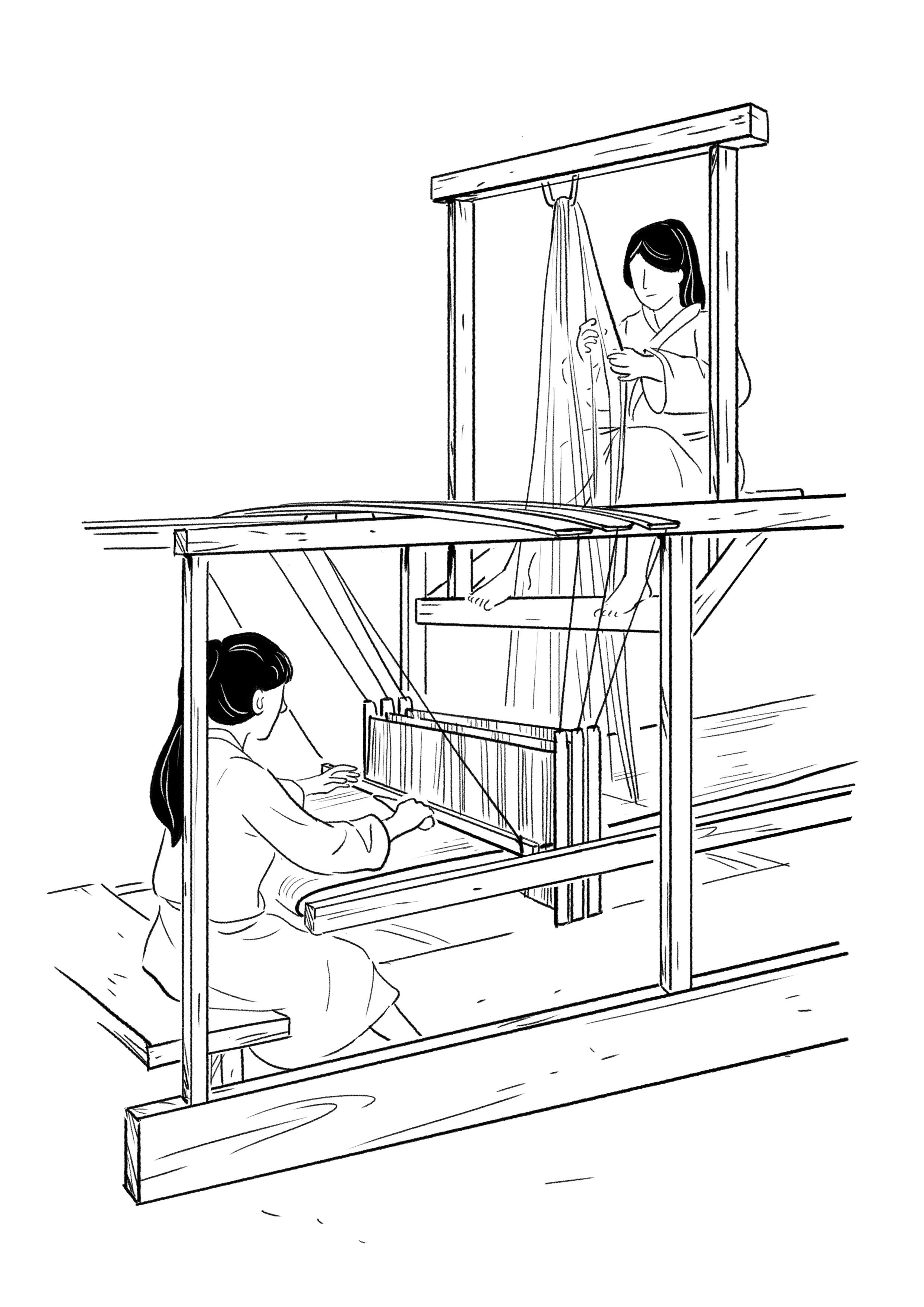
Some of the prettiest are peonies or chrysanthemums; so we call her perch a “flower tower.”
But it can be birds or animals or shapes like triangles or good luck symbols. Double happiness 雙喜 shuangxi; good luck 福 fu; long life 壽 shou. Cords from the tower can control one warp string at a time. The tower sister pulls them with both hands and maybe her toes to produce a design on the ground weave tabby. She works from a plan in bundles of string tied in the knot language. Lena 理娜 was the best at this job I’ve ever worked with. When I was throwing the shuttle on the bench, I loved to see her pictures unfold like magic in our cloth. Ah, my beautiful Lena.
Our best selling fabric is jin 錦— a silk tabby with warp stripes and delicate abstract shapes added from the flower tower.1
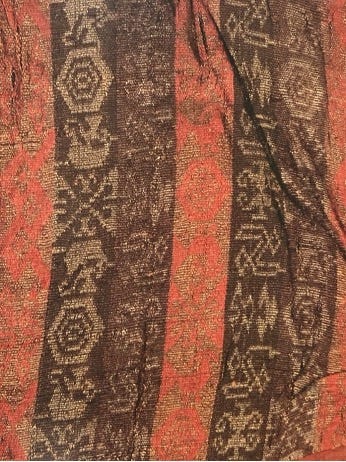
When you weave with a tower sister, you sing back and forth in time with the shuttle and beater bar. The song for jin comes from the tie-up words that go with this Pattern.
The stream looks shallow, but the little fox
Wets her tail, wets her tail.
The weaver’s ratchet wheel unlocks;
Oh, wets her tail.
In tangled weeds a woman strays;
Wets her head, wets her head.
Drinking wine put her in the family way;
Oh, wets her head.
What starts out well unraveled ends—
The finest silk must come to shreds,
Patches for clothes and quilts on beds;
Oh, wets her head.
小狐汔濟困;
濡其尾, 濡其尾。
織女曳其輪;
哦, 濡其尾。
婦人喪其茀;
濡其首, 濡其首。
于飲酒有孚;
哦,濡其首。
初吉終亂錯,
繻舊變維修,
衣袽補布破;
哦, 濡其首。
xiǎo hú qì jì kùn;
rú qí wěi, rú qí wěi.
zhī nǚ yè qí lún;
ó, rú qí wěi.
fù rén sāng qí fú;
rú qí shǒu, rú qí shǒu.
yú yǐn jiǔ yǒu fú;
ó, rú qí shǒu.
chū jí zhōng luàn cuò,
xū jiù biàn wéi xiū,
yī rú bǔ bù pò;
ó, rú qí shǒu.
I’d start with the first line, “The stream looks shallow, but the little fox. . . .” Then Lena would sing “Wets her tail, wets her tail” and pull her heddle cords. I’d throw the shuttle and sing the next line, and she’d call back, and we’d trade lines like that for hours. Sometimes we’d make up new words and laugh.
Like all the tie-up words, it’s not easy to know what story this song tells. There was a fox who lived with us in Morning Song 朝歌 Zhaoge. At first she worked for the Wizard, and he sent her to steal the spirit swords that I pulled out of the stone wall at Cloud Dream Mountain. Lena and I captured her, and she became almost like a nurse to my little boy, Gwan Zhong 管仲. They were always together.
Later, we had to flee Morning Song—that’s what comes into my thoughts when I hear, “The weaver’s ratchet wheel unlocks.” The foolishness of the child Duke that came in after Joshwee’s 州吁 rebellion made it impossible to do business in the city, and we took the looms apart and moved them to Chee state 齊國 on the Eastern Sea. On the way, the fox transformed into a woman—that’s what happens when foxes live fifty years. She wanted to marry my Zhong when he got older. I was fond of her, but I opposed it. The ways of fox fairies 狐狸精 hulijing are strange and unpredictable.
One day she was gone. That’s when “In tangled weeds a woman strayed.” She fell into her wanton fox fairy nature and possessed the body of princess Wen Jiang 文姜 of Chee. As Wen Jiang, she seduced her brother, Duke Xiang of Chee 齊襄公, and the two of them carried on disgracefully. And then “Drinking wine put her in the family way.” I fear her child could still drag Zhong into a wretched fate. “What starts out well unraveled ends.”
That’s how a story takes shape in a Pattern’s tie-up words—it grows out of your own life and gives them a meaning that you couldn’t see at first.
As for tabby, I wear it every day in my “weaver’s habit.” It’s a smock with a padded lapel (good for holding pins and embroidery needles), full sleeves that fasten at the wrists, and pants that flare a little before fastening at the ankles. The younger girls sew remnants of silk on theirs, and they look like golden pheasants or mandarin ducks.
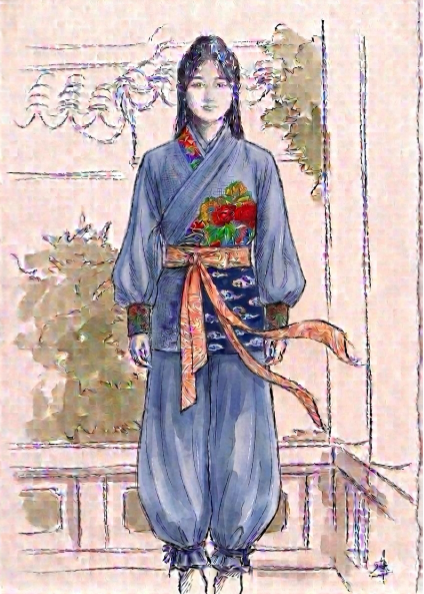
During the hard times, I often thought that the line, “The finest silk must come to shreds, patches for clothes and quilts on beds,” meant that everything fresh and good must decay and die. That’s true, of course—a hard truth. But when I see my little birds giving the scraps from the loom a new look, those words change to a prettier thought. I hear them chatter and sing, and I remember when life was the morning sun kissing my face on a day in early spring.
Read and Hear Master Fahng’s Story on Amazon
from Dieter Kuhn, et. al. Chinese Silks. (New Haven: Yale University Press, 2012), 91.